

 设为首页
加入收藏
设为首页
加入收藏
Bob Geldof
Bob Geldof, pop star in decline, was prompted by television reports of the famine in Ethiopia in October 1984 to turn crusader in the cause of reawakening the pop music world's sexual conscience. He established the Band Aid Charity, which in turn inspired USA for Africa in the U. S., to raise money for famine victims. He then employed his energies in organizing the hugely ambitious and successful Live Aid Concert, which took place in London and Philadelphia on July 13, 1985. In its wake Geldof was nominated for the Nobel Peace Prize.
At intervals he trained the spotlight of his obsessive candor on governments and institutions. In October, during a tour of six sub-Saharan countries to assess their need for famine relief, he did not flinch from asking African leaders embarrassing questions about corruption and repression in their countries. On his return he castigated members of the European Parliament for the existence of food surpluses in Europe in the face of extreme need in Africa.
Robert Frederick Xenon Geldof was born on Oct. 5, 1951, at Dun Laoghaire, County Dublin. Ireland. After leaving school he held a succession of jobs, ranging from bulldozer operator to pop-music journalist, in 1975 he and several friends formed a “new-wave” pop group called the Nightlife Thugs, soon renamed the Boomtown Rats; their performances involved releasing live rats among the audience, In 1976 the group moved to London, where it enjoyed a heady but brief success. Two singles—“Rat Trap” and “I Don’t Like Mondays”—topped the record charts in Britain in 1979 and 1980, respectively. The group failed to make an impact in the U. S. , though the latter song, which concerned a real-life shooting incident in San Diego, Calif. , brought notoriety by being banned.
At a time when pop lyrics were largely preoccupied with the deprivation of unemployment, Geldof made enemies when he accused the punk movement of hypocrisy. Nevertheless, his sincerity silenced suggestions that his fund-raising efforts were aimed at reviving his own career. In fact, the record-buying public continued to all but ignore the Boomtown Rats, while Geldof’s film career—he had taken starring roles in Pink Floyd—The Wall (1982) and Number One (1985) —was no more than moderately successful .
Live Aid Concert
The most widely seen and heard program of 1985, and perhaps of any year, was the 16-hour Live Aid Concert on July 13, a multinational, multimedia event. The concert, organized by Bob Geldof to raise money for famine relief in Africa, was held simultaneously in Philadelphia and London. Produced by Worldwide Sports & Entertainment and featuring some 60 contemporary rock and country music acts, it was carried in whole or in part by —among others—ABC - TV, ABC Radio, the Music Television cable network, the BBC, and more than 100 independent stations. It was beamed live via satellite to more than 110 countries and on a tape-delayed basis to about 40 others. In all it reached more than 1,500, 000,000 people throughout the world.
Sir Bob heads to Devon in 2003 tour
After years spent raising awareness
- and money - to help the starving millions
in Africa, Sir Bob Geldof returned to
the road for a UK tour in 2002.
It's been such a success,
it's continuing into the New Year...and
Torquay is among the venues.
Bob Geldof's highly acclaimed Sex,
Age & Death tour rolls on into 2003
- and sees the former Boomtown Rat make
a rare appearance in Devon.
Sir Bob is expected
to play some of the golden oldies -
like Rat Trap, I Don't Like Mondays,
Looking After 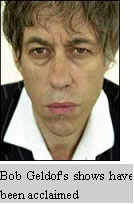 Number
One, and Mary of the Fourth Form.
Number
One, and Mary of the Fourth Form.
But most of the concert will comprise
of songs from his critically acclaimed
2001 album, Sex, Age and Death.
It was his
first album in five years, and followed
well documented personal loss - the
break-up with Paula Yates and her
death.
Sir Bob admits
his experiences cast a shadow over the
album: "I can only ever write about
that which happens to me, or my response
to situations, so this is the latest
instalment in my diary," he reveals
on his official website.
"I don't discuss
these things, literally because I can't.
I can't show you my soul. Some things
are unsayable, but maybe you try to
articulate the unspeakable in music.
So I have made an unspeakable album
"Musically,
I couldn't have sounded anything but
exhausted and weary, because that's
the place I was in.
It's very sparse and stripped down,
so it's probably not a Saturday night
going-out album. I'd say, stick it on
at two in the morning and revel in my
world of unrelenting misery." 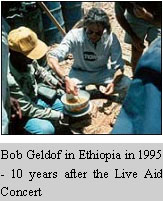
Recently,
Sir Bob issued a fresh warning over
the crisis in Africa - where millions
of Ethiopians face starvation.
A new famine there could affect twice
the number as in 1984, when Sir Bob
responded by organising Band Aid's recording
of Do They Know It's Christmas and the
Live Aid concert at Wembley.
The charity work earned him his honorary
knighthood in 1986.
His concerts aren't just about his
songs - he also talks about his take
on life, and about the injustices he
has spent almost half of his life fighting.
His shows have been well received
by fans and critics alike, and tickets
are likely to be sold out quickly.
The Story of Easter
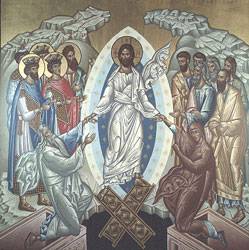
Easter(Easter Day, or Easter Sunday復活節) is a time of springtime festivals. In Christian countries Easter is celebrated as the religious holiday commemorating the death and resurrection(復活) of Jesus Christ. But the celebrations of Easter have many customs and legends.
Traditions associated with the festival survive(持續流傳) in the Easter rabbit(復活節兔子,它會帶彩蛋給乖巧小孩), a symbol of fertility(繁殖力), and in colored Easter eggs(復活節彩蛋), originally painted with bright colors to represent the sunlight of spring, and used in Easter-egg(or Easter eggs given as presents at Easter) rolling contests or given as gifts
The Christian celebration of Easter embodies(包含) a number of converging(集合在一起) traditions with emphasis on the relation of Easter to the Jewish(猶太人的) festival of Passover(逾越節—紀念猶太人自埃及獲得自由的節日), another name used by Europeans for Easter. Passover is an important feast in the Jewish calendar(猶太曆) which is celebrated for 8 days and commemorates the flight and freedom of the Israelis(猶太人) from slavery in Egypt.
Easter is observed(慶祝)by the churches of the West on the first Sunday following the full moon that occurs on or following the spring equinox(春分,March 2I). So Easter became a "movable"(可以改變日期的) feast which can occur as early as March 22 or as late as April 25
Christian churches in the East which were closer to the birthplace of the new religion and in which old traditions were strong, observe Easter according to the date of the Passover festival
Holy Week(or Passion Week--復活節前一週) begins with the observance of Palm Sunday(棕樹主日—復活節前的禮拜日). Palm Sunday takes its name from Jesus' triumphal entry into Jerusalem where the crowds laid palms at his feet. Holy Thursday(Holy Week中的星期四—聖星期四) commemorates the Last Supper(最後晚餐), which was held the evening before the Crucifixion(耶蘇被釘死在十字架). Friday in Holy Week is the anniversary of the Crucifixion, the day that Christ was crucified and died on the cross.
Holy week and the Lenten season(四旬齋) end with Easter Sunday the day of resurrection of Jesus Christ.
Feed the world and make a profit
Sir Bob Geldof has been fund-raising - not only in his campaign to cut Third World debt but also for his new media vehicle, which floated last week, reports Amanda Hall.
Sir Bob Geldof, thin and scraggly, dashes into an Italian cafe in Chelsea. It is Friday morning at 10. He's in three-quarter length cotton trousers, floppy espadrilles, a blue short-sleeved shirt and dark glasses that don't readily come off.
"I feel like shit," he says, sitting down with two builders working on his Battersea house and ordering poached eggs. "I've got to get a picnic for my daughter, it's her last day at school, where the ferk could I do that?," he says, angst-ridden and definitely in need of eggs. "God, I do feel like shit," he says again.
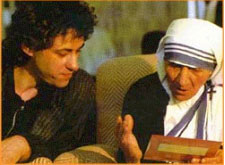 Geldof
does indeed look rough. Then again he
clearly has a genetic predisposition
for it; he looked the same 20 years
ago on stage on Top of the Pops with
the Boomtown Rats. Genes aside, however,
this has been a hectic week, or "ferking
busy," as he would put it.
Geldof
does indeed look rough. Then again he
clearly has a genetic predisposition
for it; he looked the same 20 years
ago on stage on Top of the Pops with
the Boomtown Rats. Genes aside, however,
this has been a hectic week, or "ferking
busy," as he would put it.
Tonight, after the picnic, he's performing. Yesterday and the day before he was rehearsing - in September he has a new album coming. "Sex, Age and Death," he says, pulling out of his bag a CD with a cover showing a busty blonde in a black bra.
Then last night he was at "this thing" - he doesn't want to say exactly what - but a gathering of influential political and business types to whom he talked about the elimination of Third World debt, one of his favourite campaigning topics.
In between all that he was talking to journalists about his latest business move, a listing for Ten Alps Broadcasting on the Alternative Investment Market.
The deal will see Ten Alps, an events and media production business co-founded by Geldof and Alex Connock in 1999, and a smaller company, Instant Party, which organises corporate events, carry out a reverse takeover of Aim-quoted Osprey Communications to create a $25 million media group to be renamed Ten Alps Communications.
It's the first time Geldof, who will be a non-executive director with a 12 per cent stake, has been involved in taking public a company he founded. Along with other directors, he traipsed round to institutions to $10m to fund the deal. What on earth did the City make of him?
"People get confused by me being scruffy, having a floppy face and generally being a mess," he says. "But I've got a fairly tidy mind. Yes, most think what the ferk does Geldof do? Were they cynical? Some were cynical, some brought their old records for me to sign.
"I'd take it amiss if they patronised me because I've probably got a better track record than they have. I've started businesses and made them work. You're coming to them with an opportunity and their job is to take it seriously. And if they don't, I'll walk out the ferking door. Ferk 'em, you know. In the end, I want their money but if they don't give it, ferk 'em, there's always someone else."
If only there was some economic mechanism to link Geldof's liking for "ferk" with a reduction in Third World debt - like pounds 1 for every time he uses the word - the problem would be solved in an instant.
Where did it all begin, Geldof as businessman? Curiously, his first venture, Planet 24, the TV production company sold to Carlton in 1999 for $42m, emerged from the aftermath of Live Aid, the global fund-raising concert he organised in 1985 to help famine victims in Africa.
"TV people said, great, why don't you do more of these big events? But it wasn't an event for me, it was about creating a political lobby. I was interested in creating political lobbies through the media. At the time, the environment was nowhere on the map but I'd been exposed to it in Africa, I'd seen how famine wasn't just caused by drought but by desertification, urbanisation, debt, all these are the reasons people die."
On a trip to Australia to talk to Bob Hawke, the then prime minister, about providing transport planes to support his relief effort, a friend gave Geldof a book, The Gaia Atlas to Planet Management. Its illustrations sparked an idea for a TV programme shot from space that would scan the ocean, the desert, the jungle, burrowing down into the heart of the planet.
 "I
went to the Soviet ambassador and said
I want to go into space because I want
to start the programme with a hand-held
camera view of the earth.
"I
went to the Soviet ambassador and said
I want to go into space because I want
to start the programme with a hand-held
camera view of the earth.
"The Soviet ambassador said, yeah, cool, but that I'd have to spend 18 months in Star City - I thought that'd be cool. And then the Soviet Union went and collapsed."
With it went Geldof's space plan. But by then he'd set up Planet Pictures to produce the programme and so began instead to make programming for the South Bank Show. Later he linked with another business producing the Channel 4 series The Word to form Planet 24 which would go on to make The Big Breakfast. Geldof is thought to have made about pounds 5m on the sale of the business.
"What was my part in Planet? At the time it was access, ideas, strategising, all these things, I guess. I don't know what I do really, that's the truth of it."
When Planet 24 was sold, Geldof and Connock, its then managing director, split out its radio production division and called it Ten Alps - which, roughly, spells Planet backwards.
Geldof's other best known business venture is Deckchair.com, an online travel ticket-buying business he launched in 1999.
"I had the idea sitting here," he says, and tells the story of how he got so frustrated trying to buy tickets to Disney that he decided there had to be a better way to do it.
"Irritability is a great motivator in the Geldof internal world," he says. The other is "boredom avoidance".
Deckchair.com was sold to Aim-quoted World Travel Holdings earlier this year and Geldof is a 20 per cent shareholder in the group, currently capitalised at under $20m.
The popstar-cum-activist-cum-business
operator is involved in three private
technology companies and Castaway, another
TV business, which owns the Survivor
TV concept. He doesn't invest money,
he says, just ideas, time and energy.
Nor does he play the stockmarket, nor
does he do e-mail and, despite his evident
wealth, he still panics about money.
"We were poor," he says, talking
about his childhood. "It stays
with you."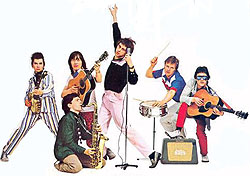
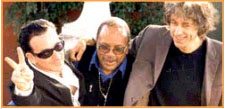
Later this month, the chaotic, creative world of Bob Geldof will roll up at the G8 summit in Genoa with Bono, lead singer of U2 and his partner in the campaign to eliminate Third World debt.
"We've wiped out a third of it already," he says. "But we now need the World Bank and the IMF to eliminate their portion - which they'll resist - but as they make $4 billion profit a year, I don't see why they can't do it. They claim they don't make profit, they make reserves, but you and I call it profit."
But for now Third World debt must wait; Geldof has a picnic to find. Before he dashes off, I want to know how in his mind the world of business and multi-million pound payoffs sits alongside his campaigning for those who have, literally, nothing?
"If a guy makes a company work in the interest of the employees, owners, clients and his contract specifies he gets a huge amount of money, then why not? If the guy has run the business into the ground, if he's been crap, he's not going to go and you have to pay him off. That's life. But if a guy deserves his wedge, so what?"
 当前位置:
当前位置: