

 设为首页
加入收藏
设为首页
加入收藏
“China; Ancient Arts & Sciences”
The Ancient Arts
and Science. the most important exhibition
of science and technology ever, come
from the People s Republic of China.
In the museum visitors can see the astounding
array of scientific and technological
innovations developed in China over
seventy centuries of human endeavor.
Over three hundred artifacts are on
display- offering only a peek at the
wealth of China s artistic and scientific
ancestry,
The sciences
of astronomy, physics, chemistry, meteorology,
seismology, technology, engineering,
and mathematics can trace their early
origins to China. From 600 AD until
1500 AD, China was the world's most
technologically advanced society. Scholars
routinely discovered scientific principles,
invented new technologies, and influenced
the development of human civilizations
around the world. The Ancient Arts and
Sciences tells the story of four of
these revolutionary Chinese technologies:
printing, papermaking, gunpowder, and
the magnetic compass. Printing and papermaking
impacted record—keeping and learning
for Chinese society. The invention of
gunpowder gave the Chinese a distinct
advantage over their enemies, changing
the nature of warfare. The compass enabled
trade and exploration in whole new ways.
Typically,
the history of human achievement has
shown that the development of new technologies
impacts the cultural practices of society.
The Ancient Arts and Sciences shows
how craftsmen used new technology to
improve their art. Crafts like bronze-casting,
porcelain-making, and silk weaving all
improved with the mastery of the raw
materials resulting from technological
advances.
Papermaking
(造纸)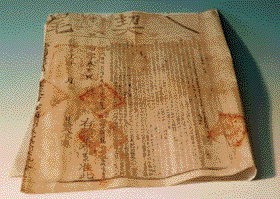
Chinese legend tells that the new invention of paper was presented to the Emperor in the year 105 AD by Cai Lun. Archeological evidence, however, shows that paper was in use two hundred years before then. Either way, the Chinese were significantly ahead of the rest of the world. The craft of papermaking relied upon an abundance of bamboo fiber to produce a fine quality paper. In ancient China, the papermaker uses only the traditional materials and methods lo produce fine art paper.
Printing(印刷)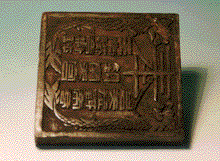
The Chinese invention of moveable type., credited to Bi Sheng in the year 1045 AD, did not significantly impact Chinese society. Three hundred years later in Europe, Gutenberg’s development of moveable type revolutionized the Western world. Why? The Chinese language uses 3000 to 5000 characters in an average newspaper. The English language, in comparison, uses 26 characters in average newspaper. Clearly, manipulating 5000 characters on a printing press look much longer than moving 26. Still, the invention of moveable type furthered Chinese technology and its role in the advancement, of human civilization .
Gunpowder(火药)
Imagine their enemy's surprise when the Chinese first demonstrated their newest invention in the eighth century AD. Chinese scientists discovered that an explosive mixture could be produced by combining sulfur, charcoal, and saltpeter( potassium nitrate) - The military applications were clear. New weapons were rapidly developed, including rockets and others that were launched from a bamboo tube. Once again, the raw materials at hand, like bamboo, contributed ideas for new technologies.

Compass(指南针)
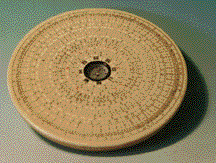 By
the third century AD. Chinese scientists
had studied and learned much about magnetism
in nature, For example, they knew that
iron ore, called magnetite, tended to
align itself in a North/South position.
Scientists learned to “make magnets”
by heating pieces of ore to red hot
temperatures and then cooling the pieces
in a North/South position. The magnet
was then placed on a piece of reed and
floated in a bowl of water marked with
directional bearings. Those first navigational
compasses were widely used on Chinese
ships by the eleventh century AD.
By
the third century AD. Chinese scientists
had studied and learned much about magnetism
in nature, For example, they knew that
iron ore, called magnetite, tended to
align itself in a North/South position.
Scientists learned to “make magnets”
by heating pieces of ore to red hot
temperatures and then cooling the pieces
in a North/South position. The magnet
was then placed on a piece of reed and
floated in a bowl of water marked with
directional bearings. Those first navigational
compasses were widely used on Chinese
ships by the eleventh century AD.
Chinese invention—printing
Chinese inventions
during the Tang and Song dynasties had
far-reaching effects. In the 700s, the
Chinese invented printing. Earlier Chinese
inventions such as paper and the use
of seals to stamp documents had paved
the way for printing.
Buddhist monks
probably developed block printing to
make copies of sacred texts and prayers.
They carved characters onto wooden blocks
that were inked and pressed onto paper.
The earliest known printed work is a
Buddhist text called the Diamond Sutra,
produced in 868. It was printed on six
large sheets that were then attached
to form a 16-foot-fong scroll.
About 1050,
the Chinese began to use movable type—pieces
of metal containing Chinese characters
that could be combined to form sentences.
The metal pieces could be used again
and again. The use of movable type enabled
the Chinese to produce many more books.
 当前位置:
当前位置: