

 设为首页
加入收藏
设为首页
加入收藏
与校运动会有关的词汇
player运动员 sportsman 男运动员 coach 女运动员 referee 教练员
spectator裁判员 cheering 观众 sportswear啦啦队 match 运动服装
match比赛 whistle口哨 stopwatch秒表 scoreboard记分牌
school record校记录 trial match预赛 semifinal半决赛 finals决赛
champion冠军 second place亚军
赛场跑法知多少
sprint 短跑
one – hundred – metre dash 一百米短跑
four- hundred – metre race 四百米短跑
middle – distance race 中距离赛跑
long- distance race 长距离赛跑
cross-country race 越野赛跑
marathon race 马拉松赛跑
obstacle race障碍赛跑
hurdle race 跨栏赛跑
110 metre high hurdles 110米高栏赛跑
The Polar Bear Swimming
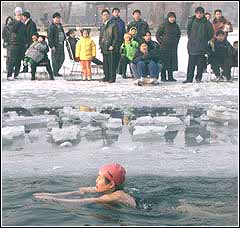 The polar bear swimming (冬泳) is a very popular water sport among many people, because they want
to keep themselves fit. Swimming in the cold water
can improve the physical capacity(改善身体机能)and also it is very
exciting.
The polar bear swimming (冬泳) is a very popular water sport among many people, because they want
to keep themselves fit. Swimming in the cold water
can improve the physical capacity(改善身体机能)and also it is very
exciting.
Polar bear is the name of the bears which live in the North Pole. They like cold water, so people use the word “polar bear swimming.”
This sport first started 100 years ago in the US, and many clubs attracted (吸引) large numbers of polar bear swimming lovers to join them. Actually, in this sport, what a person need is a swimming suit and the encouragement to challenge self-limit (挑战自身极限的勇气)and the icy waves. But the personal physical condition is also important. The sudden change of the temperature can be very dangerous to those sick people.
不规则动词中的规则
初二的同学刚学习一般过去时态时会接触很多不规则动词的过去式,不少同学以为要记住它们太难。其实,只要你仔细观察这些不规则动词,找出其内在的规则,记起来就不难了。以人教版初中英语课本里的动词为例,主要有以下几条规则:
一、AA型——原形、过去式两者形式一样。这些词又分为两类:
1.两者发音一样,都以字母“t”结尾。
cost—cost cut—cut hurt—hurt
put—put let—let beat—beat
2.过去式与原形发音不同。
read [ri:d]——read [red]
二、AB型——原形、过去式两者不一样,有以下几种形式:
1.以“ell”结尾的不规则动词的过去式,将“ell”变为“old”或“elt”。
tell—told sell—sold smell—smelt
2.以“eep”结尾的不规则动词的过去式,将“eep”变为“ept”。
keep—kept sleep—slept sweep—swept
3.以字母“w”结尾的不规则动词的过去式,常把“w”前面的字母改为“e”。
blow—blew draw—drew grow—grew know—knew throw—threw
4.以“ing”结尾的不规则动词的过去式,常把“ing”变为“ang”。
sing—sang ring—rang
5.改变动词原形中间的那个元音字母。
begin—began come—came drink—drank fall—fell
get—got give—gave hold—held ride—rode
run—ran shine—shone sit—sat swim—swam
wake—woke write—wrote
6.下面六个动词的过去式都是在原形单词的辅音字母之后加上“ought”或“aught”,若原形单词中有字母“a”,则“aught”,否则加“ought”。
bring—brought fight—fought buy—bought think—thought catch—caught teach—taught
另外,还剩下少数的单词,同学们要认真把它们记好。
动脑筋
WHAT ARE WE?
I have many brothers in my family. Some of us are big, and others are small. Different people in different countries—like different ones in my family.
In my family we have three famous brothers. People in Europe and South America like to play one of my brothers. They love him a lot. Especially in Germany, Brazil and the UK, people love him better than in any other countries. They usually play him with feet.
In the USA, people love another brother of mine. When they play, they usually have five persons in a team against another.
People in China, Cuba(古巴), Japan, Russia and even in the USA like my third brother. They have very good women teams.
Of course I have many other little brothers, too. Some of them are soft, and some of them are hard; some are bigger than an egg, and some are smaller.
Do you know what we are?
Keys: all kinds of ball sports
怎样正确选用形容词的级别?
形容词的比较等级可分为原级、比较级和最高级三种形式。怎样正确判断在句中该用哪一个级别呢?
一、原级的用法
原级的用法比较简单,一般当句中没有别的比较对象时,要用原级。但下面一些特殊用法要特别注意:
1.表示A和B两者比较,程度相同,用句型:A+动词+ as+形容词原级+ as + B
例如:Tom is as honest as John. They’re both good students.
2.表示A和B两者比较,A在程度上不如B,用句型:A…+not + as/so+形容词原级+ as + B
例如:He is not as(so)tall as I. But he is older than I.
二、比较级的用法
两者比较,说明“a比B更……一些”用句型: A + 动词 + 形容词的比较级 + than + B
例如:Mary is happier than Jane. She has many good friends.
注意:有时因为被比较的对象不需说出来,句中就会省略“than + 被比较的对象”。这时需要根据上下文的暗示来判断形容词的级别。
例如:–Are you feeling better now?
–Yes, I feel well. Thank you.
需注意的比较级的用法
1.在比较级的前面可用much, even, still, a little等修饰,但不可用very来修饰。
例如:Japan is a little larger than Germany. They’re both small countries.
2.表示倍数:…times + 形容词的比较+ than…
例如:Our room is twice larger than theirs. But theirs is more beautiful than ours.
3.表示“大三岁”,“高二厘米”时用“表示数、量的词+比较级”来表示。
例如:I am two years older than you. I’m taller than you.
4.“比较级 +and + 比较级”表示“越来越……”
例如:The earth is getting warmer and warmer. It’s a world problem.
5.“the + 比较级……the + 比较级”译为“越……就越……”
例如:The busier he is, the happier he feels. 他越忙越高兴。
6.“the + 比较级 + of the two”译为“两个中比较……的”
例如:He is the better of the two. They’re both weak in English.
三、最高级的用法
表示三者或三者以上(人或物)的比较,其中有一个在某一方面超过其他几个时,用最高级。用句型:A+ 动词 + the + 形容词最高级 + of(in)…
Tom is the happiest of us all. We all feel happy for him.
This park is the most beautiful of the three. It’s also the biggest of all.
注意:当用介词短语表明形容词最高级的比较范围,介词后的名词或代词与句中的主语是用一类事物,并把主语包括在内时,介词用of,当只说明是在某一时间、空间范围内的比较时,介词用in。
The largest sports meeting
The Olympics are held every two years. They alternate between the winter and the summer Olympics: the winter games, then two years later, the summer games; then two years later the winter games again. Athletes from around the world compete against each other for gold, silver, and bronze medals. The Olympics is a way to bring the countries of the world together in friendship.
The summer Olympic games include such sports as track and field, gymnastics, swimming and tennis. Sports in the winter Olympics include ski jumping, figure skating, bobsledding, hockey, and snowboarding. Many Olympic events take place in a stadium .The opening and closing ceremonies also take place in the stadium. A flame is lit during the opening of the summer and winter Olympic games. It stays lit until the closing ceremonies.
The Olympic summer games are being held in Beijing in 2008. Perhaps you, or someone you know, will be taking part in the largest sports meeting in the world!
Words
alternate /C:l5t[:nit/ v. 交替
athlete /5AWli:t/ n. 运动员
compete /k[m5pi:t/ v. 比赛;争夺
include /in5klu:d/ v. 包括;包含
gymnastics /dVim5nAtiks/ 体操
figure /5fig[/ n. 图形
bobsledding /5bCbslediN/ n. 雪橇车比赛
hockey /5hCki/ n. 曲棍球
snowboarding /5sn[ubC:diN/ n. 滑板运动
stadium /5steidi[m/ n. 体育场;运动场
ceremony /5serim[ni/ n. 仪式;曲礼
flame /fleim/ n. 火焰
lit /lit(light的过去分词)点燃;照亮
编顺口溜巧记单词
单词的记忆,是英语学习的一道难关。下面给同学们介绍一种巧记单词的方法。
把含有相同字母的组合或具有相似发音的单词放在一起,编成顺口溜。这样会起到事半功倍的效果。下面试举若干例。
1.boy(男孩)—toy(玩具)—joy(高兴)—soy(酱油)
一个boy, 看toy就joy,然后跳进了soy。
2.cat(猫)—hat(帽子)—fat(肥的)—rat(耗子)
一只cat,戴着一顶hat,捉住了一只非常fat的rat。
3.village(村庄)—knowledge(知识)—bridge(桥)—college(大学)
走出village,学好knowledge,通过bridge,走进college。
4.shy(害羞的)—try(尝试)—fly(飞逝)—cry(哭泣)
千万不要shy,只管大胆try。一旦有机会fly,你就只有cry。
5.lazy(懒惰)—study(学习)—crazy(疯狂)—easy(容易的)
请你不要lazy,认认真真study。只要你去crazy,一切都会easy。
6.tall(高的)—ball(球)—wall(墙)—hall(大厅)
一个男孩很tall,带着ball,经过wall,走进hall。
7.fool(傻子)—tool(工具)—pool(水池)—cool(酷/凉快)
一个fool,拿着tool,跳进pool,非常cool。
8.goat(山羊)—coat(上衣)—boat(小船)
一只goat,穿着一件coat,上了一条boat。
9.monkey(猴子)—donkey(驴)—long key(长钥匙)
一只monkey,骑着一头donkey,拿着一把long key.
10.cattle(牛)—rattle(拨浪鼓)—battle(战斗)
一头cattle,背着rattle,加入了battle。
幽默时空
母与子
Mother and Son
Mother: Motherland, you are right my dearest mother!
Little son: Motherland, you are right my dearest grandmother!
Mother: Why do you say so?
Little son: Isn’t your mother my grandmother?
母亲:祖国啊,你才是我最亲爱的妈妈!
小儿子:祖国啊,你才是我最亲爱的姥姥!
母亲:你为什么这么说?
小儿子:难道你的妈妈不是我的姥姥吗?
 当前位置:
当前位置: