

 设为首页
加入收藏
设为首页
加入收藏
扩展资料一
构词与词类转换
词类的相互转换可以用下面这个三角形来表示,以加深理解。
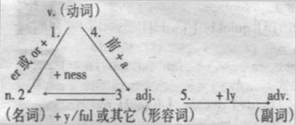
I.动词变名词:在它的后面加上-er或-or就变成从事该项工作的人了。如:
work—worker(工人),teach—teacher(教师),read—reader(读者),visit—visitor(参观者),invent—inventor(发明家)
II.名词变形容词:
1)某些表示天气情况的名词后面加y构成形容词。如:
rain—rainy, snow—snowy, cloud—cloudy, wind—windy
注意:有时需双写或去e。如:sun—sunny, fog(雾)—foggy(多雾的),ice—icy(结冰的)
2)有的名词后加-ful也可构成形容词,意为“有……的”,加-less构成含否定意义的形容词,意为“没有……的”或“不……的”。如:
care—careful(细心的)—careless(粗心的),help—helpful(有帮助的)—helpless(无助的)
3)方位名词后加-ern构成形容词,注意有时读音发生变化。如:
south [au] —southern [Λ], north[
 ]—northern[
  ],east—eastern, west—western
4)表示国家的名词变形容词时需加-n或-ese。如:
China—Chinese, Japan—Japanese, America—American, Australia—Australian
III.形容词变名词需在后面加上-ness,表示某一性质或状态。如:
good—goodness(善良,仁慈),kind—kindness(厚道,仁慈),happy—happiness
IV.动词变形容词其前面要加个a,表示“……着的”。如:
sleep(睡觉)—asleep(睡着的),wake(唤醒)—awake(醒着的)
V.形容词变副词通常是加ly。请记住口诀:一般直接加,“元e”,去e加,“辅y”改i加,“le”结尾e改y。如:
quick—quickly, true—truly, happy—happily, possible—possibly
注意:有些形容词和副词同形。如:fast, high, hard(adj.坚硬的)—(adv.努力地),early等。
How to write a letter
Generally speaking, letter writing can be classified into three categories: formal, semiformal, and informal. In each of these three tapes of letters, language and tone differ. While slang and unnecessary abbreviations are not allowed in formal or semi- formal letters, depending on the person to whom you are writing.
A formal letter is normally written to a person in an official capacity. It requires two addresses: the address of the writer and the date appear in the top right hand corner; the name, the title, and salutation is “Dear sir / Ma dam” (if the recipient’s name unknown )or “dear Mr. / Mrs./ Dr.___. ”Examples of formal letters are a letter of application for employment, a letter of trade, a letters of apology, or a letter of application for admission to a college. Some principles for a formal letters are: 1. You should not use slang in your formal writing. 2. You should not use oral English words in your formal writing .3. You should not use contraction in your formal writing. While a formal letter, you must follow this basic pattern:
(1) Tell your reader why you should write this letter.
(2) Clarity your reasons or provide with facts.
(3) What do you expect your react?
Like a formal letter, a semi-formal letter is written in polite language and a humble tone; no slang is allowed. However, unlike a formal letter, a semi-formal one does not require two addresses. Examples of semi-formal letters include a letter to a family friend who is not your friend directly, a letter to teacher concerning your academic work, or a letter to your resident advisor concerning your absence from a floor meeting. You can write “ thank you ”not “thanks”. “nine o’clock” not“9:00”
Slang and abbreviation are allowed in informal letters, because they are substitutes for informal conversation, proving a way of communicating with close relative or friend who are far way. Casual, chatty language and tone are allowed in informal letters, although they should be suited to the recipient .the tone and language you use in a letter to your parents is different from those you use for your brothers or your friends.
Writing an envelop of a letter in English is different form writing one in Chinese. For a Chinese envelop , the out side address(the address of the receiver)must be on the upper –middle side , and the side . but for an English envelop , however , the outside address(the writer’s address )should be on the lower-right side . But for an English envelop, however, the outside address is on the lower-right side, while the return address is on the upper-left side. If the envelope is from China to English –speaking countries, it is best to write bilingually.
Winter
Winter is cold, and the days are shorter. Many trees shed their leaves; many birds winter in the south.
Winter sports fans naturally like winter. Skiing, sledging and ice-skating are popular with them. Some people even enjoy swimming in the river in the dead of winter. The Winter Olympic Games are great event in the sports world.
“If winter comes, can spring be far behind? ” This famous line is the last line of the poem “Ode to the West Wind.” Do you know who its author is? It is P. B. Shelley, an English poet.
冬天
冬季寒冷,白天较短。许多树木都落下叶子,许多鸟儿都到南方过冬。
热衷于冬运的人自然喜欢冬天。滑雪、乘雪橇、溜冰,都是他们喜爱的。有些人甚至在隆冬时分,仍然喜欢到河里游泳。冬季奥运会是体育界的一大盛事。
“冬天来了,春天还会远吗?”这著名的诗句是《西风颂》的最后一行。你知不知道作者是谁呢?作者就是英国诗人雪莱。
扩展资料二
Chinese New Year in Canada
春节是全世界炎黄子孙欢度的最大节日,加拿大温哥华的华人是怎样庆祝这一节日的呢?请看-
Chinese New Year is on February 7. People will celebrate it in many ways. For example:
Before the New Year, people pay off debts and clean their houses.
On New Year's Day people wear new clothes and shoes.
Children get money in little red envelopes. It is called lai see or "lucky money."
People say "Gung hay fat choy." This means "Best wishes. I hope you make lots of money this year."
Year of the Ox.
It is year 4695 on the Chinese lunar (moon) calendar. The Chinese name each year after one of 12 animals. 1997 is the Year of the Ox.
Christmas 的字母含义
每年的12月25日,西方有一个一年中最为隆重的节日,那就是妇孺皆知的Christmas Day(圣诞节)。它原是为庆贺耶稣诞辰的一个宗教节日。现已成为西方的一个普遍的节日。对于圣诞节这方面的知识,我们已有了一些了解。诸如:寄圣诞贺卡,吃圣诞晚餐,唱圣诞颂歌,装饰圣诞树,以及圣诞老人为孩子们带来圣诞礼物,还有那个可爱的red-nosed deer。但是人们对为什么叫Christmas或者是说Christmas这个单词有什么内涵就知之不多了。其实就Christmas这个词来说,它的每个字母都有其特殊的含义。
1. C is for the Christ Child who was sleeping on the hay.
C代表睡在干草上的小耶稣基督(Christ Child. )
2. H is for the Heavenly Host who worshipped him that day.
H代表出生时关爱他的天主(Heavenly Host)。
3. R is for the radiance on Mary's holy face.
R代表圣母玛利亚的容光(radiance)。
4. I is for the lowly Inn-a poor and humble place.
I 代表那个低矮简陋的小客栈(Inn).
5. S is for the Star that shines to guide the shepherds there.
S代表以光芒引导牧童的星星(Star)。
6. T is for the Travelers who brought him treasures rare.
T代表来自东方送给他(耶稣)珍贵礼物的三个游客(Travelers)。
7. M is for the Manger where He laid His little head.
M代表耶稣基督出生在里面的马槽(Manger)。
8. A is for the Angels who hovered round His bed.
A代表在他床的上方盘旋的天使。(Angels)。
9. S is for the Savior who brought peace and hope to earth.
S代表把和平和希望带给人间的救世主。(Savior)。
漫话“圣诞节”
圣诞节(Christmas Day)是每年的十二月二十五日,它是西方国家的一个重要节日,也是一个全民性的节日。
圣诞节是从一个耶稣(Jesus)降生的神话故事得来的。相传巴勒斯坦北部小城拿撒勒有一个木匠约瑟的未婚妻玛利亚从圣灵而怀孕。约瑟打算悄悄退掉婚事。一天夜里,天使要约瑟娶玛利亚,并给她的儿子取名为耶稣,但耶稣的生日无从考究。据罗马(Rome)历书记载,罗马的基督教徒是从公元336年才把12月25日作为耶稣生日来纪念的,12月25日是罗马历书的冬至节,万物开始复苏,也许是因此被基督教会定为圣诞节。
圣诞节的庆祝活动是丰富多彩的。圣诞除夕夜是12月24日晚到25日晨,在那晚,人们举行隆重的大型音乐会,演唱圣诗“平安夜”等。圣诞节这天,各教会都进行圣诞节礼拜或圣诞节弥撒仪式,十分隆重。有的教会还演出圣诞剧。
圣诞节的重要风俗是大人扮演圣诞老人(Father Christmas)给孩子们送礼物。传统“圣诞老人”白须红袍,驾鹿橇从北方而来。有的家长在圣诞节之夜孩子们入睡后,把礼物装在孩子们床头的长统袜里,这样孩子们第二天就会认为礼物是圣诞老人送的。不少家庭在自家庭院或屋内还放置圣诞树(Christmas tree),用松、柏等常青树枝扎成,挂上灯笼、彩花等,人们围着圣诞树载歌戴舞。
圣诞节晚上各家各户还要举行圣诞节会餐,食物丰盛,且多设一个席位以留给“主的使者”。另外,亲友之间还要互相赠送圣诞礼品和贺年卡。
美国人早餐吃什么?
1.coffee咖啡
喜欢喝咖啡的美国人很多。很多超市(supermarket)里除了提供很多不同风味的新鲜咖啡豆让顾客选购(店里通常附有研磨机)外,货架上的奶精口味也是经常五花八门。当然,有些人喝咖啡时是不加糖或奶精的,这样的咖啡就叫黑咖啡"black coffee"。
2.cereal由谷类做的早餐
cereal加牛奶,是很多美国人几乎每天早上都会吃的东西。到了美国超市里,也总是可以看见整排的货架上摆了各式各样cereal。许多美国人喜欢同时买两、三种不同口味的cereal摆在家里,吃早餐时就可以自由调配(mix and match)了。
3.oatmeal燕麦片
oatmeal也是美国人常吃的早餐之一。他们常买原味的燕麦片自己煮(水煮约一分钟),有时也买加味处理的、只要加水冲泡的速溶燕麦片(Instant Oatmeal),两者之间的价格差距颇大,这里燕麦粥的口味一律是甜的。
4.pancake薄煎饼
这种原料以面粉为主,加水混和再用少许的油煎成的薄饼,也是桌上常见的早餐之一。食用时,美国人喜欢在pancake上浇些syrup(蜜糖),再加奶油(cream)。
5.waffle 威化饼
成份和pancake大同小异的waffle,因为经过烤制的关系,比pancake多了几许香脆感。基本上,可以用从超市买来的薄煎饼粉(pancake mix),加水和鸡蛋混合,再用waffle iron(烘威化饼的铁模)烤熟即可。如果家里没有waffle iron,超市里也有不同的口味且用烤面包机加热即可食用的冷冻waffle,是很方便也蛮干好吃的早餐。
有关吃喝方面的日常用语英语
Makes my mouth water! 使我流口水.
Thank you for fixing the meal! 谢谢你做了饭!
I have sweet tooth.意思就是:我特别好吃甜东西。
Eyes are bigger than one's stomach:是指在吃饭时点的食物往往比实际吃的多这一现象。
写一段文章讲述上周六赴宴的情况,以宴席上的饭菜质量特色做简单描绘。
 当前位置:
当前位置: