设为首页
加入收藏
设为首页
加入收藏
Lesson 77教学设计方案
Teaching Objectives:
Students should be able to grasp the dialogues , make similar dialogues and write about things that make them happy and sad.
Language Focus:
later on, do the cooking, make + 宾 + adj. , know much about
Properties: Tape-recorder
Teaching Procedures:
I. Organizing the class
1. Ask the students to get ready for class.
2. Greetings between the students and the teacher.
3. A duty report.
II. Revision
Check the homework left in the last period.
III. Leading-in
1. Ask some students: “Can you use a computer? How well can you use it? Can your parents use it?”
2. Ask some students to answer the above questions and say something about the computer.
3. Play the tape of Dialogue A for students to listen and ask them the following questions:
(1 ) Can Han Mei use a computer?
(2) How about her parents?
(3) Who can help them?
4. Ask students to answer the above questions.
5. Listen to the dialogue again and ask the students to repeat after the tape.
6. Read the dialogue after the tape.
7. Ask the students to retell.
IV. Teaching Dialogue B
1. Ask some students about their weekend: “Did you have a nice weekend?” and questions like: “Can you look after yourself? Can you do the cooking?”
2. Play the tape for the students to listen and ask them to retell the dialogue.
3. Play the tape and ask the students to repeat after it.
4. Ask the students to work in pairs and recite Dialogue A and B.
5. Ask the students to make similar dialogues.
V. Writing practice
1. Ask the students to answer the questions in the exercise book.
2. Ask the students to write about the time when they are happy or sad.
VI. Exercises in class
翻译句子。
1.我叔叔因为抽烟太多,得了癌症。
2.因为我父母不太懂计算机,我不得不自学如何使用它。
3.你父母一定很担心你叔叔。
4.上周末,因为我父母去医院看我叔叔,我不得不在家照顾我家弟弟、做饭。
Keys:
1. My uncle has cancer because he smokes a lot.
2. Because my parents don’t know much about computers, I have to learn to use it all by myself.
3. Your parents must be very worried about your uncle.
4. Last weekend, because my parents went to see my uncle in hospital, I had to take care of my younger brother at home and do the cooking.
VII. Homework
1. Finish exercises on page 91.
2. Writing: Write about a time when you felt unhappy or happy and what you did to make yourself feel better.
VIII. Summary
请把下列句子排序。
A. Yes, I had a good time.
B. I went to the Fragrant Hill and enjoyed the apple trees.
C. Did you have a nice weekend?
D. Were there a lot of people there?
E. What did you do?
F. Yes, it was very crowded.
G. Where you very tired after you came home?
H. I was OK.
Keys:
|
A |
C |
E |
B |
D |
F |
G |
H |
IX. Writing on blackboard
|
Lesson 77 Sentences make 1. My parents bought a computer for me. = My parents 1. What makes you happy? bought me a computer. 2. It makes me very sad. 2.I don’t know how to use it yet. 3. I have to learn to use it all by myself. 4. Can you teach yourself? 5. They want to see him in hospital. |
Lesson 77多媒体教学设计方案
Teaching Objectives:
Grasp the dialogues, make similar dialogues and write about things that make them happy and sad.
Teaching Procedures:
1.(学生活动导入新课)设问导入第一部分对话的教学,引导学生谈论有关computer。
2.(图片)展示computer图片,教师通过自己的语言引入第一部分对话的相关表达用语,并让学生从对话中猜测新词汇yet和by myself的意义。
3.(录像演示)让学生观看A部分对话的情景,学习新词汇cousin和engineer,并让学生回答问题。
•1) Can Han Mei use a computer?
•
•2) How about her parents?
•
•3) Who can help them?
•
•4) What does Han Mei’s cousin do?
4.设问引入B部分对话的话题,通过询问学生在家干些什么,引入对话中Paul照顾他的弟弟。
(录像演示)让学生观看B部分对话的情景,学习新词汇cancer,care,及短语take care of,并让学生回答问题。
Why did Paul have to take care of himself and his little brother?
(Because his parents went to see his uncle in the hospital.)
5.(课件演示)让学生看动画,跟读对话,熟悉对话,并表演对话。
(学生活动)学生自己编类似的对话,并分角色表演对话。
6.(图片)通过两种相反的脸部表情向学生展示高兴和悲伤的神态,教学新词汇sad。
(学生活动)让学生展开讨论,首先让学生谈谈自己高兴和悲伤的几件事。
•It makes me very happy when my friends come to see me.
•It makes me very happy when we won the match.
•It makes me very sad when I think of my little dog’s death.
•It makes me very sad when I hear the bad news.
•Last week my sister left home. I felt sad. But now she comes back. My family are very happy.
然后让学生练习分辨悲喜的事情。
1. We shall have a holiday next month.
2. I will come to her birthday party.
3. Yesterday I lost my new pen.
4. Our English teacher said to me, “You are a good student”.
5. My father bought me a new bike.
6. I helped an old woman carry water last Sunday.
7. My friend, Liu Mei is ill.
8. Our team won a match.
9. Let’s go boating.
10. I failed (考试不及格) in the last maths exam.
7.课堂练习
用括号中所给单词的适当形式填空
1. There are all _________ of things in that shop. (kind)
2. The girl is learning to swim all by _________. (she)
3. His mother looks _________ about his English study, (worry)
4. Everyone likes the_________ girl very much. (care)
5. When he came in, we all stopped _________ with him at once. (talk)
答案:1.kinds 2.herself 3.worried 4.careful 5.to talk
8.布置家庭作业。
1. Finish exercises on page 91.
2. Writing: Write about a time when you felt unhappy or happy and what you did to make yourself feel better.
3. Finish off the workbook exercises.
Lesson 79 教学设计方案
Teaching Objectives:
Ask the students to talk about holiday plans; Grasp the language points and grammar: modal verbs
Language Focus:
1.Vocabularies; hometown, visit = go to see, super = excellent/splendid, have a wonderful time, be late for, instead
2. Grammar: will, modal verbs + v. 原形
Properties: Tape-recorder, Overhead projector
Teaching Procedures:
I. Organizing the class
1. Ask the students to get ready for class.
2. Greetings between the teacher and the students.
3. A duty report.
II. Revision
1. Ask 2 ~ 3 students to retell Ling Feng’s diary.
2. Dictate language points learned in the last period.
III. Leading-in
1. Say to the students: “The May 1st holiday is coming. Do you have any plans for the holiday?”
2. Ask the students to work in groups and discuss their plans for the holiday.
3. Call out several groups to say their holiday plans.
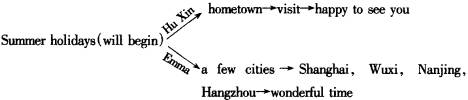
4. Lead the students to Emma’s and Hu Xin’s holiday plans.
IV. Teaching Dialogue
1. Before listening:
Before playing the tape for the students to listen, ask the students to find out the answer to the question: What are Emma and Hu Xin going to do in their summer holidays?
2. After listening:
Ask the students to answer the question and ask more questions:
(1) When will the summer holidays begin?
(2) Where’s Hu Xin’s hometown? Why will she go there?
(3)Where is Emma going in the holidays?
3. Listen and repeat (with books closed) the dialogue.
4. (Open the books) Read aloud after the tape.
5. Ask the students to pay attention to:
(1)hometown家乡
(2) visit = go to see
(3 ) super(口语) = excellent; splendid
(4) have a wonderful time
6. Ask the students to work in pairs and make similar dialogues about holiday plans.
7. Call out 3 ~ 4 pairs to act out their dialogues.
V. Puzzle dialogues
1. Ask the students to finish the puzzle dialogues exercises by themselves.
2.Check the answers: Boys read Column A and girls read Column B.
3. Teaching language prints.
(1) be late for
①He’s often late for school.
②Don’t be late for the important meeting.
(2)instead 代替,顶替,表示前面的事情没做,而是做了后面的事。
①He didn’t answer me. Instead, he asked me another question.
②If Harry isn’t well enough to go with you, take me instead.
[注]instead一般位于句首或句尾,但不能位于祈使句前面,也不位于句中。instead所在的那个句子一般是肯定形式,前面那个句子一般是否定形式。
instead of 为介词词组+并列成分(n., pron., adv., 介词短语, doing)
She went there on foot instead of by bus.
They had tea in the garden instead of in the house.
He answered this question instead of that.
I stayed in bed all day instead of going to work.
I’ll go instead of you.
(3)will, modal verbs( may, should, must, can 及否定) +动词原形
need+动词原形时,为情态动词;用于need + to do时,为实义动词。
4. Ask the students to talk about the things they can do and can’t do in the box in Exercise 3 on a page 93.
VI. Exercises in class
从B栏中找出与A栏句子相应的答语。
A B
1. Excuse me. Do you speak English? a. Thank you.
2. You’re a teacher, aren’t you? b. Only a little.
3. What’s the matter with you? c .No, I’m not.
4. What does the man do? d. He s a doctor.
5. Shall we get some meat? e. Yes, do please.
6. Sit down, please. f. I’ve got a headache.
Keys: 1.b 2.c 3.f 4.d 5.e 6.a
VII. Homework
1. Finish exercises on page 93.
2. Make a dialogue about holiday plans.
VIII. Summary
用情态动词填空。
1. My mother is ill, so I ________ look after her at home and ________(not) go to the evening Party.
2. You________(not) play on the road. It’s too dangerous.
3. —_________ I return the book in a week?
—No, you _________ (not) .
4. Li Ming is late today. He _________ be ill, but I’m not sure.
5. You _______ try your best not to make the same mistake.
Key: l. have to, can’t 2.mustn’t 3.Must,needn’t 4.may 5.should
IX. Writing on blackboard
|
Revise modal verbs: may, should, must, can, need |
Lesson 80教学设计方案
Teaching Objectives:
Develop the students’ four skills of listening, speaking, reading and writing; Enable the students to grasp five kinds of simple sentences; Revise the whole unit.
Language Focus:
1. Five kinds of simple sentences: S + V, S+V+O,S+V+P, S+ V + InO + DO, S+ V+ O+ C
2. Phrases; in the end, forget to do/doing, make sb-do, tell sb. not to do, look into, with these words
3. Revise indefinite pronouns.
Properties: Tape-recorder, Overhead projector
Teaching Procedures:
I. Organizing the class
1. Ask the students to get ready for class.
2. Greetings between the teacher and the students.
3. A duty report.
II. Revision
1. Talk about the writing homework.
2. Ask 2 ~ 3 students to read their good writings.
3. Dictation: dictate all the language points of the unit.
III. Listening practice
1. Pre-listening: tell the students to get ready for listening and what they’ll hear.
2.While-listening: ask the students to bear the listening comprehension questions on Page 94 in mind and try to find out the answers.
3. After- listening:
(1) Ask the students to tell briefly what they heard.
(2) Check the listening comprehension questions.
IV. Reading practice
1. Let the students read the passage quickly to find the answer to the question “Why did the monkey laugh in the end?”
2. Ask the students to close the book and play the tape of Lesson 80 for the students to listen to the story.
3. Ask the students to answer the reading comprehension questions on Workbook.
4. Explain the language points.
(1) in the end = at last; finally最终,最后,终于,后面不接of介词短语
They won the game in the end.
We found his house in the end. He was waiting for us at the door.

(2)make sb. do 使(做某事或成为)
Whew! That makes my eyes ache. Please take it away.
You may take a horse to the water, but you can’t make him drink.
(3) with these words
with 介词短语在句中作状语,表示一个伴随情况。
The teacher came in with a book in his hand. We all stopped talking.
The woman, with a boy on each side, begged from door to door.
5. Group work: Ask the students to work in groups of three and act out the passage.
V. Writing
1. Ask the students to finish the writing exercise on Page 29 with indefinite pronouns.
2. Check the answers.
3. Teach the language points.
(1)forget to do 忘记去做某事
Don’t forget to post the letter.
He had forgotten to bring his umbrella and he was wet through.
(2)forget doing 忘记(曾做过或发生过某事)
I shall never forget seeing the Sea for the first time. It’s very beautiful.
I shall never forget finding the rare coin in the garden.
4. Read the dialogue in roles.
VI. Grammar
1. Teach the five kinds of simple sentences.
2. Ask the students to do the match exercise.
3. Give more examples of simple sentences and ask the students to say the kind they belong to.
(1)We can keep it warm. (S+ V+ O+C)
(2)I won’t let you go.(S+V+O+C)
(3) Mr. Wu teaches us English. (S+ V + InO +DO)
(4) She bought me some tomatoes. ( S+V+ InO + DO)
(5) The story is interesting. (S+ V+ P)
(6) She speaks French.(S+V+ O)
(7) Lily came. (S+V)
VII. Word puzzle
1 Competition :Ask the students to work in groups of four and find as many words as possible in the puzzle.
2. Check the answers.
3. Give the winner( s) prize( s) .
VI. Revision of the four units
Go over the checkpoints 15-19 in the book with the students.
IX. Exercises in class
用动词正确时态填空
1. Last year we _________ (learn) a lot of English. We _________ (read) many stories, and _________(do) many exercises. Next year we _________(learn) more English. But first we ______ (have) a rest.
2. Soon Li Lei_________(go)to_________(help)his uncle on the farm.
3. Next month the twins_________(visit) some other places in China.
Keys: 1. learned/learnt, read, did, will/are going to learn, will/are going to have 2. is going, help, 3.will/are going to visit
X. Homework
1. Finish exercises on workbook in this unit.
2. Retell the story about the tiger and the monkey.
3. Revise the whole unit.
XI. Summary
指出下列简单句的类型:( Subject ), V ( Verb ), O( Object ), P ( Predicative ), InO ( Indirect Object) , DO( Direct Object)
1. I wish you happy.
2. The Great Wall has saved a lot of land.
3. Granny Wang often helps others.
4. The teacher came in.
5. This guy is very funny.
6. He took away my dictionary.
7. His father bought them many new books.
8. Lily’s mother made her stay alone at home.
Keys: 1.S+V+ O+C 2.S+V+O 3. S+V+O 4.S+V 5.S+V+P 6.S+V+O 7. S+ V+ InO +DO 8. S+V+O+C
XII. Writing on blackboard
|
Lesson 80 The Tiger And The Monkey The five kinds of simple sentences Language points 1. S+V 1. in the end = at last; finally 2. S+V+O 2.makesb.do 3. S+V+P 3.with these words 4. S + V + InO + DO 5. S+V+O+C |
 当前位置:
当前位置: