

 设为首页
加入收藏
设为首页
加入收藏
Lesson 77 教学设计示例(一)
一、教学内容
1.词汇(略)。
2.句型:1)Catch the ball!2)Don’t worry. 3)I’m not good at basketball. 4)You can pass
the ball like this.
3.复习祈使句的否定式。
二、教具
录音机;一个篮球;与本课所列各项运动相关的图片。
三、课堂教学设计
1.值日生报告。教师与学生通过问答形式复习表示打招呼、问候、相互介绍的日常用语。
2.打开书学生看图。利用图片和问答形式引出本课生词。这几张图,也可作为上个单元中重点句型的复习来使用。例如教师可以问:
T:What can you see in the picture?How many boys/trees can you see in the picture?或:How many cars can you
see in the picture?(要求学生用:I can’t
see any.来回答)
3.教师利用手中篮球,请一个男同学到前面来,通过传、接球演示,引出以下对话:
T:Come on,×××!Catch the ball!(将球传过去)传递一、两个来回后,教师故意没有接住:
T:Ouch!
启发学生说出:
S:Sorry!Mr×××.Are you OK?
T:Yes,I’m fine.Don’t worry.
4.再请一位不大会打篮球的女同学到前面来。这位女同学会面露难色。启发她说出:
S:I’m sorry.I’m not good at basketball.
教师提问:
T:Then what’s your favourite sport?
S:(根据刚才教师出示的各种图片,选其一)I like swimming/ping-pong/volleyball…
5.放课文第1部分录音,学生跟读数遍,分小组练习。数分钟后,请两组同学到前面表演(注意提示学生传递球时注意周围同学或公物,如教室地方小,完全可以到室外演练)。
6.指导学生做本课第2部分练习。
7.指导学生做书后练习册习题。
8.布置作业
1)抄写生词;2)练习朗读本课对话;3)完成练习册习题。
Lesson 77 教学设计示例(二)
● 教学目标:
1.复习句型: What is your favourite…? My favourite …is …
2. 祈使句的初步用法。
3.简单谈谈你所喜爱的运动。
● 教学用具:
录音机,投影仪,图片,微机及相应媒体资料等。适当也可准备一些球类,如:乒乓球、足球、篮球等。可随意准备一些小的物品,备用。
● 教学步骤:
Step 1 Revision
本节课的Duty Report可让值日生汇报完必说的内容后,让同学们自由提问,或值日生向全班同学提问。如:Would you like to answer my questions? What is your favourite food?
My favourite food is … What about your favourite sport?
My favourite sport is…等, 利用值日生的每日工作很自然的引出本节课的话题。
Step 2 Read and act
一、学课文
1.利用媒体资料学习第一段对话的第一部分。[见媒体资料1-20-1]
2.让一名同学与老师一起模仿第一段对话的第一部分。老师可用一小物品砸一同学的头(注意别太重)。
二、学单词。
1. 利用发音规律教单词: sport
pass easy
2. 利用构词法和实物教单词:
basket+ball=basketball
Step 3 Presentation
三、学习第一段对话的第二部分。
由老师和同学一起演示对话的第二部分(可事先准备)。老师可拿一篮球,以边变换自己所站的位置,边自问自答说:What’s your favourite sport? My favourite sport is basketball. 换一乒乓球再说:What’s
your favourite sport? My favourite sport is ping-pong.
和一同学配合做一动作,老师把篮球递给同学,说:Catch! 同学没接住后说:I’m not good at basketball. I don’t like it very much. It’s hard. It’s
not easy. 同学拿出一乒乓球说:I’m good at ping-pong.
I like it very much. It’s easy. You can pass the ball
like this. 老师说:Is it easy? OK. Let me
try.
老师找一部分同学练习这几句话,再在小组中练习直至练熟。
听录音,并当堂背诵。
Step 4 practice
两人小组或三人小组练习编对话,运用以上所学句型。
Step 5 Ask and Answer
看77课第二部分。请看图:What’s the boy
doing? He is swimming. What’s your favourite sport?
My favourite sport is …
以两人小组或三人小组为单位,练习以上句型。每小组着重描述一、两种体育运动。简单说说为什么喜欢这项体育运动。
Step 6 Consolidation
1. Most of the boys
like playing and watching f_____________(足球).
2. Ling Tao doesn’t like
playing b____________ (篮球).
3. What’s your f____________(最喜爱的)sport?
Roller-skating.
4. I can read very well,
because it’s e_______(容易的).
5. Winter is very long near,
and we can s_________(滑雪) and s_________(滑冰).
6. 她语文学得很好。
She ______ _______ _______
Chinese.
Keys: football basketball favourite
easy skiing skate is good at
Blackboard Handwriting
Unit 20 What’s your favourite sport? Lesson 77 New Words Come on! Don’t worry! sport pass easy be good at basketball = basket + ball It’s easy. You can pass the ball like this. |
● Teaching aims
“四会”掌握短语:be good at, play basketball, come on
句子:What’s your favourite sport? 及答语:My favourite sport is…
动词:try,pass
● Key points
掌握句型:What’s your favourite sport?
My favourite sport
is…
● Difficult points
正确使用这些句型和短语。
● Teaching methods
设定情景(根据Part 1)教学重点句型,然后让学生巩固练习。
● Teaching aids
录音机、投影仪、微机、课件Lesson 77教学演示.ppt、球。
● Teaching procedures
Step 1 Revision
1. Morning report.
2. Revise the dialogue:
T: Hello! My name is… What’s your name?
S: My name’s…How are you?
T: Fine, thank you. And you?
S: I’m fine too.
T: Do you like Ping-Pong?
S: No, I don’t.
T: Let me help you.
首先是老师与同学之间的对话,然后同学之间对话。
Step 2 Presentation
1.用图片、实物、手势、微机课件(Sport.swf中Words 的情境)教:swimming,
skiing, ice skating, volleyball, tennis, table tennis,
roller-skating, chess, come on,be good at,play basketball,easy,pass,try。并启发学生用一些动词造句。
2.用图片或多媒体展示(Sport.swf中Play的情境,需静音、隐藏文字),教师首先介绍对话的场景(Part
1):
This is Ling Feng and this
is David. They are playing basketball with some other
boys. Ling Feng is not good at basketball. He doesn’t
like it very much. His favourite sport is ping-pong.
He can pass the ball like this. It’s easy. Can you
try it?
然后找几名好学生试着介绍这个场景。
Step 3 Listening and
practice
1.让学生听此对话的声音并跟读。
2.打开书,两人朗读对话并交换角色,让2~3组同学来表演对话,或与计算机一起扮演角色(Sport.swf中的情境,Play中需适时地控制静音和隐藏文字)。
Step 4 Presentation
教师叫一名学生回答。
T: What’s your favourite sport?
S: My favourite
sport is…
教师借助板书强调这一句型,并利用图片或多媒体展示歌曲(Sport.swf中song的情境)一边听一边教授sport及涉及的一些词及短语:swimming,
skiing, ice skating, volleyball, tennis, table tennis,
roller-skating, chess.
Step 5 Practice
然后叫几名同学重复练习这一句型,可做Chain drill练习(step 4)。
Step 6 Consolidation
听写练习:
1. I'm not good at basketball.
2. I don't like volleyball very much.
3. You can pass the ball like this.
4. Let me try it.
5. What’s your favourite sport'?
先找几个同学说出自己的答案,然后再将正确的答案写在幻灯片上或用微机展示(见Lesson 77教学演示.ppt)。
Step 7 Summary
让学生总结这一课的重点。
Step 8 Workbook
完成Ex.l和Ex.2,两人一组谈谈自己及图片中人物喜欢的体育运动。
Step 9 Exercises
(-)将下列词组译成英语。
1.打网球 _____________ 2.接住这只球_____________
3.擅长于_____________
4.你最喜欢的运动______ 5.像这样传球_____________ 6.让我试试___________
7.下棋_____________
Answers: 1. play tennis 2. catch the ball 3. be good at 4. your favourite sport 5. pass the ball like this 6. let me try 7. play chess
(二)用适当的介词填空。
1. Let me help you. Do it
________ this.
2. This is a picture ________ my family.
3. Take these bags ________ the room.
4. This is my watch. Please look ________ it for
me.
5. How many glasses ________ water can you see?
6. Some children play games ________ the tree
7. I think I’d like a bottle of orange. What ________
you?
8. What’s wrong ________ your computer?
Answers:
1. like 2. of 3. to
4. after 5. of 6. under
7. about 8. with
Step 10 Homework
1.预习下一课。 2.表演本课对话。
Writing on blackboard
Lesson 77 I’m not good at basketball. It’s easy. What’s your favourite sport? My favourite sport is… |
Lesson 78 教学设计示例(一)
一、教学内容
1.词汇(略)。
2.句型:1)复习 can的用法; 2)Do you
want a go? 3)Don't throw it like that! Throw it like
this!
二、教具
录音机;一个抖空竹。
三、课堂教学设计
1.复习上节课所学词汇。
2.教师手持抖空竹,请一个同学做如下演示:
T:Hi! Look! I have a yo-yo. Do you want a go?
(启发学生猜这句话的意思。教师也要做出邀请对方玩抖空竹的姿态。)
S:OK! Thanks!
(教师低声嘱咐这个同学,故意做出扔抖空竹的错误姿势。)
T:Don't throw it like that!
教师接过抖空竹,做出正确姿势,说:
T:Throw it like this!
启发学生猜这两句话的意思。教师可板书这两个句子。把抖空竹交给那个学生。学生一下子“学”会了。教师可启发他说:Oh, it's easy!
再请另一位同学,与教师重复刚才的表演,只是在最后,总也做不出正确的姿势(教师嘱咐他不能做出正确的姿势),这时教师启发这个学生说:Oh,
it's too hard.
3.放课文第一部分录音,学生跟读两至三遍。请几位同学到前面,表演刚才的小对话。
4.放课文第二段录音,学生边读,边复习这些词汇。两人一组,就这些体育活动相互提问。教师也可以不断地问全班同学是否会从事这些运动。建议教师考虑将本课部分内容挪到室外进行。
5.指导学生做练习册习题。
6.布置作业
1)抄写生词;2)练习朗读本课对话,完成练习册习题。
四、难点讲解
1.want a go 要试一试
短语中的go是名词,表示“尝试”的意思。go通常作动词使用。例如:
1) They go to school every
day. 他们每天上学。
2) Let's go home. 让我们回家吧。
2.play basketball/football 打篮球/踢足球
在类似的短语中,表示球类的名词前面不使用定冠词 the。play这个动词可译为:打、踢、玩等。
3.It's too hard. 太难了。
too表示“太……”的意思,通常放在被它修饰的形容词或副词之前。例如:The car is too full. 汽车里装得太满了。
Lesson 78 教学设计示例(二)
● 教学目标
1.复习句型: Can you…?
2. 祈使句否定式的初步用法。
3.简单谈谈你会什么,不会什么。
● 教学用具
录音机、投影仪、图片、yo-yo等。适当也可准备一些书籍、学习用品之类、球类等,随意准备一些小的物品,备用。
● 教学步骤
Step 1 Revision
Duty Report汇报完必说的内容后,让同学们自由提问,或值日生向全班同学提问。如:Would
you like to answer my questions? What about your favourite
sport? My favourite sport is… Why? Say sth about your
favourite sport. Can you play yo-yo?等。
Step 2 Presentation
1. 老师事先准备好一yo-yo问学生,也可老师自问自答,Excuse me, what’s
this in English? 老师再问一同学,Can you play it? Do you want a go? 最好找一名不会玩yo-yo的同学,从而引出Don’t throw it like
that. Throw it like this.
教单词yo-yo, throw, 词组like this
照这样练习几组,在按事先分好的小组练习对话,最好每组都有一个yo-yo,供练习句型使用。
2. 老师可再设计一个使用否定祈使句的情景。如:拿起这名同学的书或铅笔盒,
问:Is this your book / pencil-box?
答:Yes, it is.
问:May I put on the floor?
答:Don’t put it on the floor, please. Put it on my desk. 可用“连锁练习”的方式,即老师问第一位同学,该同学回答,然后,这位同学再问第二位同学,第二位同学回答后,再问第三位同学,照这样,以为组为单位,练习这段对话。
3. 老师和还可把事先准备好的东西故意乱放在一些地方,引出学生说:Don’t put them there. Put them here. 如:把扫帚放在桌上,并提问:May I put it on the desk? 学生就会说:Don’t put it on the desk. Put it behind the door.
4. 如班上有同学上课说话,老师可提醒他:Don’t talk. Listen to me.再如班上有同学上课坐的姿势不正或趴桌子,老师可提醒他:Don’t sit like this. Sit straight.
Step 3 Read and say
看媒体资料1-20-5.asf
听声音后,让同学们背诵课文。
Step 4 Ask and Answer
1. 和同学练习问答:Can you
ride a bike? 可两人小组练习。也可鼓励同学问你问题。
可事先和一同学准备一下。
A: Can you dance?
B: No, I can’t. It’s too hard. But I can sing. It’s easy.
A: What about you?
B: I can sing, too.
2. 看媒体资料Can you
do it. swf 中情境一
教单词
可利用知识迁移:car---hard---card like---ride sky---fly Kate---skate
sing swim volleyball
jump
Step 5 Consolidation
1. Don’t t_________(扔)
around the wasted paper on the floor.
2. I can’t do it. It’s too
h_______(难).
3. I r_______(骑车) a bike to school every day.
4. I often play c________(打牌)with
my friends on Sunday.
5. 放风筝__________
6. 打排球____________
7. 你想试试吗?
Do you _______ _______ _______?
8. 你会跳高吗?会.
_____ ______ jump? Yes,
I can.
Keys: throw hard ride
cards fly a kite play volleyball
Blackboard Handwriting
Unit 20 What’s your favourite sport? Lesson 78 New Words Don’t throw it like this! Car---card---hard like---ride sky---fly It’s easy. Kate---skate sing swim volleyball jump It’s too hard. |
Lesson 78 教学设计示例(三)
● Teaching aims
1.掌握“四会”单词及词组,throw,hard ride,swim,fly,card,basketball,jump,sing。了解词义及搭配。
2.掌握下列用语:
(1) Do you want a go?
(2) Don't throw it like that.
(3) It's very easy.
(4) It’s too hard.
● Key points
1.掌握“四会”单词和词组。
2.正确、灵活运用日常用语。
● Difficult points
掌握“发出指令”的重要语段。
● Teaching methods
借用实物、幻灯或微机引出新词,设置情景教授新句型。
● Teaching aids
录音机、投影仪、图片、微机、课件Lesson 78教学演示.ppt。
● Teaching procedures
Step 1 Revision
(1)Morning report.
(2)根据第77课的第一部分,学生自编对话。叫出几组学生到前面表演。
(3)使用图片或微机课件(动画Sport.swf中Words情境)复习一些词汇:sport, swimming,
skiing, ice skating, play volleyball, tennis, table
tennis, roller- skating, chess.(详见课件Lesson 78教学演示.ppt)
Step 2 presentation
1.运用手势及微机动画Can you do it.swf教授:throw a yo-yo, ride a bike, swim. skate, jump, sing, play volleyball,
play cauls, fly等动词或短语。
2.用学生知道的动词做don’t的游戏。告诉学生Pick
up your pen. Don't use your hands.看谁会这样做。
Step 3 Read
and say
放第一部分的影片1-20-5.asf,学生听并跟着读,教师解释Do you want a go?教授 like this和like that短语时,提醒学生注意以前学过的It looks like a cat.句型
Step 4 Presentation
教师在黑板上画出“吉姆”。或用微机、幻灯片出示情境(动画Can you do it.swf情境三,需静音)说:Jim, can
you throw a yo-yo? 替吉姆回答:Yes, I
can. It’s easy. 让全班重复这个对话,接着分两组进行练习。
在黑板上画出“凌峰”,或用微机、幻灯片出示情境(动画Can you do it.swf情境三,需静音)说:Ling Feng,
Can you throw a yo-yo? 替凌峰回答:No, I can’t. It’s too
hard! 提醒学生注意too的含义,像上面一样练习。
用微机、幻灯片出示情境(动画Can you do it.swf情境二),将已学知识What’s
your favourite sports与新知识Can you do
it联系起来,帮助学生温故知新。
Step 5 Presentation
再一次向学生强调句型:Can you do this/ that? Can you throw a yo-yo? 然后引出Part2的学习。可借助微机、幻灯片用play
volleyball/ fly a kite/play cards等短语进行连锁操练(动画Can you do it.swf情境一)。
Step 6 Practice
再根据此句型进行分组自由对话。
A: Can you play football?
B: Yes. I can. It’s easy. Can you ride a bike?
C: No, I can't. It's too hard.
学生回答正确时,教师就说:Yes, that's right. 或者Good.
根据学生的学习需求,设计对话,借助微机、幻灯片,进一步操练关于Can you do it的交际用语(动画Can you do it.swf情境四)
Step 7 Consolidation
1. He throw the ball to me and I ________
it.
A. take B. make
C. catch D. carry
2. You can do it ________.
A. like it B. like that
C. like
D. like these
3. Look at the picture on the wall. _________ you
like it?
A. Do B. Can
C. Could D. Are
4. Can you ________ a bike?
A. give B. ride
C. do
D. swim
5. It's a yo-yo. Do you want _________?
OK. Thanks.
A. go B. going
C. to go D. a
go
Answers: 1.C 2.B 3.A 4.B 5.D
Step 8 Summary
让学生总结本课重点。
Step 9 Workbook
1.Do Ex. 1
两人一组,口头做。
2.Do Ex. 2.
3.Do Ex. 3 以问答形式完成。
Step 10 Homework
1. 预习下一课。
2. 做下面的词汇练习,记住所学单词。
根据句意填入适当的单词,首字母已给出。
1. There is a boat in the
r ____.
2. Can you play b______?
3. Skiing is h____ for me.
I can't do it.
4.The girl can't f______
a kite now.
5. My bike is broken, so
I can’t r______ it.
6. Now the students in class
one can s______ some English songs.
7. Do you want a go? Yes,
let me t______ it.
8.The bottle isn't empty.
It's f_____ of water.
9. The question isn’t hard,
it is e______.
10. How many g_____ of milk
can you see? I can see only one.
Answers: 1. river 2.basketball
3. hard 4. fly 5. ride 6. sing 7.try 8. full 9. easy
10. glasses
Writing on blackboard
| Lesson 78 Do you want a go? Don't throw it like that. It’s very easy. It's too hard. |
Lesson 79 教学设计示例(一)
一、教学内容
1.词汇(略)。
2.句型:复习上一节课的祈使句型。
二、教具
录音机;几件学习用具;一个风筝。教师可考虑将本课前半部分安排去室外进行。
三、课堂教学设计
1.复习。教师与学生进行以下问答练习:
T:(叫起一个学生)Can you swim?
S1:Yes, I can. It's easy.
T:(问全班同学)Can he/she swim?
Ss:Yes, he/she can.
T:(叫起一个学生)Can you fly a kite?
S2:No, I can't. It's too hard.
T:(问全班同学)Can he/she fly a kite?
Ss:No, he/she can't.
多重复几次这样的练习。为增强交际效果,也可以这样做:
T:(叫起一个学生,假设为A)Student A, can
B swim?
SA:Sorry, I don't know. (转向Student B)Can you swim?
SB:Yes, I can, It's easy.
SA:(面向教师)Yes, he/she can.
以上这两种做法,要在今后的教学中不断坚持下去。
2.教师将风筝拿出,通过放风筝这一过程,让全班学生感受以下各句:
1)That’s a nice kite!
2) Do you want a go?
3) Run with it like this.
4) It’s too hard. Oh, dear!
Is it broken?
5) Let me help you. Do it
like this. See?
6) Ah! Yes. Oh, look! It’s
high!
7) Great! Look! I can do
it, too!
如教师自己不会放风筝,可问学生哪个会放。即使没有人会,也可请学生一试,并完成上述练习。如果这部分内容在室内进行,则效果不佳。
3.(回到室内)放课文录音,学生跟读两遍,纠正发音。
4.按本课要求做Make a
survey. 在进行这项活动时,要宣布规则;问方与应答方必须用英语,否则无效。
5.指导学生做练习册习题。
6.布置作业
1)抄写生词;2)练习朗读本课对话及句型;3)完成练习册习题。
四、难点讲解
1.Do it like this. 照着这个样子做。
这是个祈使句,句中的like是介词,意为:像……一样。如果你发现别人做得不对头,可以说:Don't do it like that! 别那样做!
like还可用作动词,意为:喜欢。例如:
A:Do you like bananas? 你喜欢吃香蕉吗?
B:Yes, very much. 非常喜欢。
Lesson 79 教学设计示例(二)
● 教学目标
1.熟练运用祈使句肯定和否定的用法。
2.通过放风筝学会简单叙述一种游戏的玩法。
● 教学用具
录音机、投影仪、风筝(图片)等。
● 教学步骤
Step 1 Revision
※ 建议1
如有条件,本节课在室外上。真正上一节放风筝的实践课。
教单词和一些基本句型。然后在操场上课。
哪一组放风筝成功,鼓励学生用英语叙述放风筝的过程。至少说5条:1. Have a friend
hold a kite. 2. Run fast against the wind. 3. Set
the kite free. 4. Pull on the string. 5. The kite
can fly higher and higher. 没成功的,也鼓励他们说说失败的原因。说出一两点即可。
※ 建议2
在教室上。一边看媒体资料1-20-6.asf或动画《祈使句.swf》中情境三,一边教单词。run
high then
静音
让学生一边看一边学习叙述放风筝的过程。
放音
让学生跟读,并背诵整个对话或背其中的一段。也可让学生以文段的形式叙述放风筝的过程。
Step 2 Presentation
完成第79课第二部分。并回答书中的两个问题。
Step 3 Consolidation
1. This kite can’t fly, because it’s b__________(坏了).
2. Thank ____________(谢天谢地).
3. G________(太好了)! I can do it.
4. What do the Chinese have for__________(早餐).
5.Is that so? That’s r________(对).
6. 带着风筝跑。
______ _______ the kite.
7.让我帮你。
Let me ______ _______.
Keys: broken goodness Great
breakfast right Run with help
you
Blackboard Handwriting
Unit 20 What’s your favourite sport? Lesson 79 New Words Don’t throw it like this! run then 叙述使放风筝的过程 light---high a nice kite---- want a go---- run with it---fly higher and higher |
Lesson 79 教学设计示例(三)
● Teaching aims
“四会”掌握:
Run with it like this.It’s high.
“三会”掌握:
be broken.
● Key points
继续学习“发出指令”的表达方法。
● Difficult points
“四会”句型的掌握及灵活运用。
● Teaching methods
设置情景,利用图片或实物来教授句型。以多种练习形式进行巩固和加强。
● Teaching aids
风筝(图片)、录音机、卡片、投影仪、微机及动画。
● Teaching procedures
Step l Revision
1.Morning report.
2.复习第78课所学的动词及短语。
3.重习第77、78课关于祈使句的语言项目(动画《祈使句.swf》中的情境一、情境二)。而让学生四人一组分别进行练习,这样他们有更多的说的机会。
Step 2 Presentation
在听第一部分声音前提问:Can Ann fly the kite?让学生带着问题听声音(动画《祈使句.swf》中的情境三),然后检查答案,再放声音,学生听声音并跟读。
教师向学生解释生词run,high,great。great就是“good”的意思,这个词是在令人激动的事发生的时候使用。(例如:No
homework today.Great!)
Step 3 Read
and act
1.将全班分成两组,分别做这一对话的听力练习(动画《祈使句.swf》中的听力),看一看哪组做得快、做得准。
2.让同学两人一组,练习这一对话,交换角色。然后找几组同学到前面表演。
Step 4 Listen
播放歌曲Let your kite fly high(动画《祈使句.swf》中的歌曲),让同学稍稍放松和休息一下,再做下面的活动。
Step 5 Practice
将全班同学分成若干组,每5人一组。然后其中一名同学调查其他四名同学的姓名及爱好,并按课本第二部分填写表格,最后统计出他们当中相同爱好的人数及他们的姓名。
| Name |
Favourite Sport |
Step 6 Consolidation
改错,把错误处的序号填入题前的括号内。
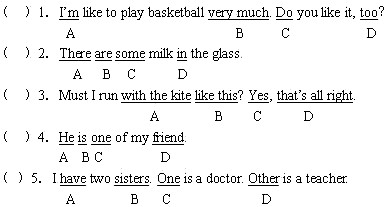
Answers: 1. A 2. B 3. D 4. D 5. D
Step 7 Summary
1.让同学总结祈使句的特点,不足的地方老师补充,并展示动画《祈使句.swf》中的句型。
Catch the ball!接球!
Don't worry. 别担心。
Don't throw it like that.
别象那样扔。
Throw it like this. 象这样扔。
Try it!试一试!
Run with it like this.象这样带着它跑。
Do it like this. 象这样做。
Run!跑!
Step 8 workbook
1.Do Ex.1.
2.Do Ex.2 独自做完后,全班订正。并叫同学总结出:祈使句的否定形式是在动词前加Don’t
3.Do Ex.3 先领同学读一遍,然后让同学进行分组练习,并表演。
Step 9 Homework
预习下一课。
Writing on blackboard
| Lesson 79 Run with the kite like this. Great! It’s high. |
Lesson 80 教学设计示例(一)
一、教学内容
1)单元复习。
2)学习元音字母o及其字母组合发音;学习重音和语调。
3)复习情态动词can的用法;小结祈使句型。.
二、教具
录音机;音标卡片。前面使用过的球类等。
三、课堂教学设计
1.值日生报告。
2.使用简易体育器材,如篮球等,复习在前面两课中所学到的对话。重点练习:What’s
you favourite
sport? 及应答;含有情态动词can的问句及应答等。
3.教师出示/
 /,
/,  /,/
/,/  /,/u:/,/u:/,/u/,/an/等音标卡片,学生认读。放课文第一部分录音。学生跟读两遍,并自己小结元音字母O及其他字母组合的读音。
4.放录音,学生模仿课文第二部分的重音和语调。
5.听录音,模仿
Read and chant。数分钟后,请几位学生朗读,教师予以讲评。
6.组织学生做本课第4、第6两部分内容。
7.听力训练。放录音之前,可给学生一分钟时间看第92、93页上有关题目。放录音两至三遍,学生绘出答案,教师订正。
8.如时间允许,学唱Let
Your Kite Fly High。
9.学生阅读复习要点(20),教师解答学生问题。
10.布置作业
完成练习册习题。
11.小测验
1)听写本单元中重点词语和主要句型。
2)94页汉译英。
Lesson 80 教学设计示例(二)
● 教学目标
1.复习语音语调。
2. 复习句型What’s your favourite…? My favourite …is….用法。
3.学会填写表格,如:健康表,游泳证等。
● 教学用具
录音机、投影仪、图片、游泳证或健康卡片等。
● 教学步骤
Step 1 Revision
听录音完成第一、二、三部分。第三部分容易引起学生的兴趣,可组织个人模仿、小组模仿、集体模仿等多种形式。
Step 2 Presentation
会填写表格。
| Children’s Swimming Club Name ______________ Age_____ Sex _____ School _______ Student No._______ Class ________ Medical history _____ Blood Type _____ Home Add ____________ Postal Code_____ |
Step 3 Listen and answer
做workbook Part 5。
Step 4 Read
1.看媒体资料1-20-8.asf并模仿跟读。
2.听录音背诵课文。
Step 5 Sing the song
Step 6 Consolidation
( ) 1. A.
so B. nose
C. photo D. long
( ) 2. A. some B. do
C. some D. brother
( ) 3. A. too
B. food C. look
D. school
( ) 4. A. how B. down
C. brown D. throw
5. 你可以这样传球。
You can ______ _______ like
this.
6. 她篮球打得不好。
She ______ _______ _______
basketball.
把以下短文改成第一人称。
Jim is a basketball fan.
He is very good at playing basketball. Michael Jordan(改成中国球星) is his
favourite basketball player. Jim is on the school
basketball team. Every Friday afternoon, they play
basketball after class.
Keys: A B C D pass
the ball isn’t good at
I am a basketball fan.
I am very good at playing basketball. X X X is my
favourite basketball player. I am on the school basketball
team. Every Friday afternoon, we play basketball after
class.
Blackboard Handwriting
Unit 20 What’s your favourite sport? Lesson 80 语音 can---fan play---player fan be good at basketball / football player football / basketball team Michael Jordan Ronaldo |
Lesson 80 教学设计示例(三)
● Teaching aims
1.“三会”掌握:
/u/ /u:/ /R/ /Q/ /[u/ /au/
2.复习本单元的“发出指令”及can引导的一般疑问句。
● Key points
掌握音标、重音和语调。
● Difficult points
总结、归纳字母、字母组合的发音。
● Teaching methods
让学生总结发音的规律,并在学习歌曲的同时复习本单元内容。
● Teaching aids
幻灯机、录音机、写有本课音标的幻灯片,如有条件还可用多媒体展示本课内容。
● Teaching procedures
Step l Revision
l.Morning report.
2.给同学两分钟的时间,用本单元学过的重点句式进行自由对话,然后叫几组同学到前面来表演。
Step 2 Presentation
1.教师出示幻灯片,或在黑板上写出so,nose,over,photo.让学生找出他们含有的共同音标[[u],教师总结并板书.

 ou/ow/au/ oa/ ow/ [u/
2.听这部分声音。
Step 3 stress
and intonation
l.让学生合上课本听第二部分的声音(动画《祈使句.swf》中的句型),提示学生注意每个句子的重音。然后再放声音,让学生跟着读。学生在听声音时,教师用手势指出重音。
2.向学生讲解语调:表示“说话者陈述一件事”用降调,“提一个问题”或者“流露出说话者的某种感”用升调。
3.通过示范表演,说明Yes的几种不同用法。
(1)Yes.(降调)肯定
(2)Yes?(升调)疑问
(3)Yes!(降调)感叹
(4)Ye-es(升一降调)不确定
Step 4 Read
and chant
让学生听第三部分的音乐(动画Sport.swf中的song),然后学唱。最后根据自己喜爱的运动将歌词改动来演唱;
Step 5 Ask and answer
先向学生解释右边表格中的几个生词:age(年龄),address(地址),Postal code(邮政编码)。然后让同学两人一组根据各自情况填写表格,最后教师给出参考答案。
Step 6 Listen and
answer
1.对学生说:Open your workbook,listen and answer.
2.放两遍录音,学生回答问题后,再放录音,解释难点。
3.找学生说出正确答案。
Step 7 Read
首先让学生快速浏览Workbook Ex.6中的几个问题,然后再快速阅读课文找出正确答案。如果时间允许,听口语录音带,并跟着读。
Step 8 Sing the song
学生跟着录音学唱这歌曲Let your kite fly high(动画《祈使句.swf》中的歌曲),可安排一次唱歌竞赛,以提高大家学英语的兴趣。
Step 9 Summary
和同学一起复习本单元重点Checkpoint 20,如同学有疑问,给以解释。
Step 10 Consolidation
( )
1. It’s ______easy question.
A. a
B. an C.
the
D./
( )2.______you swim? No, I______.
A. Are, am not B. Do, don’t
C. Do, not do D. Are, not
am
( )3. Please let me ______ you.
A. to help
B. helping
C. help to
D. help
( )4.That’s a nice bike. Do you
want______?
A. to go
B. go
C. a go
D. going
( ) 5. Would you ______ something
to drink? What about a cup of tea?
A. want
B. like
C. help
D .know
( ) 6. There are ______ cups on
the table. And there is ______ water in them.
A. many, many B. much, much
C. many, much D. much, many
Answers: 1.B 2.B 3.D 4.C 5.B 6.C
Step 11 Workbook
1.Do Ex.1 教师领读,然后让学生熟读。
2.Do Ex.2 让学生写出拼写正确的单词。
Answers: nose; sun/ son; boat;
food; how; so; not; who; about; full; no/ know; sock
3.Do Ex.4 要求同学抄写一遍
Step 12 Homework
1.复习本单元。
2.预习下一单元。
Writing on blackboard
| Lesson 80
|
 当前位置:
当前位置:
 ou/ow/au/ oa/
ow/
ou/ow/au/ oa/
ow/